
- By admin-theme
- Uncategorized
- 0 Comment
Future of Tiles: How Large-Format & Vitrified Tiles Are Changing Adhesive Requirements
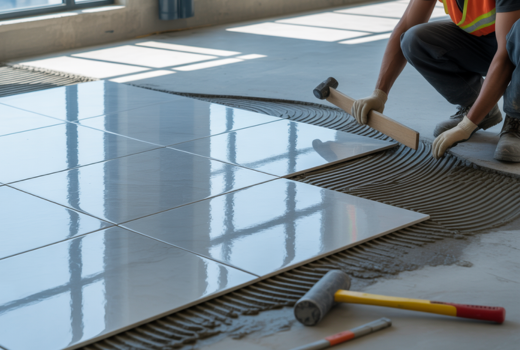
The trend of tiles in India has evolved very fast in the last 10 years. Builders and house owners are now opting to use large format tiles and vitrified tiles to give it a clean, seamless, and more contemporary appearance. These tiles are strong, low maintenance and aesthetic-however, they also burden the installation materials particularly the tile adhesives. As more people are interested in tile glue adhesive in India, it has been necessary to learn these emerging needs by architects, contractors and tile installers.
The emergence of Large-Format & Vitrified Tiles
The tiles that used to come in conventional sizes such as 2×2 feet have been increased to 4×8 feet or even larger. Big format tiles according to the Indian tile industry are increasing by almost 20 percent every year. These tiles have a reduced number of grout lines and continuity in designs hence they are suitable to modern interior.
High porosity combined with low strength Tiles (vitrified tiles) are currently considered to be among the most popular materials in both urban house construction and large-scale construction works. Their non-absorbent and smooth surface, however, does not make traditional sand-cement mixtures be the right mix.
Why Adhesive Requirements are changing?
1. Desire to have Greater Bond Strength
Tiles of large format and vitrified tiles have a stronger bonding requirement because of:
- Minimal surface absorption
- Higher tile weight
- Poor flexibility of big slabs.
This has augmented a demand of best tile adhesive in India that can provide high tensile strength and protracted adhesive.
2. Increased Resistance to Cracks and Flexibility
Movements of buildings are caused by changes in temperature and structural load. The movement cannot be absorbed by the traditional mortar resulting in cracks or debonding of tiles. Modern adhesives offer:
- Elastic properties
- Shock resistance
- Better load distribution
This is particularly in the case of tile adhesive in floor in India whereby heavy foot traffic is the order of the day.
3. Adhesives to problematic areas
Advanced formulations are required in areas such as: swimming pools, exteriors, and wet surfaces. You can search for:
- Swimming pool tile adhesive India.
- Swimming pool adhesive tile in India.
- Indian tile adhesive in the pools under water.
These adhesives are meant to work under the continuous moisture, hydrostatic pressure and chemical exposure.
4. Increase Of Speciality Cladding and High-Rise Applications
Commercial buildings are also being exterior clad with tiles. This change has forced the requirement of:
- Bonding adhesives that are stronger in nature and are based on polymer.
- Weather-resistant materials
- India is one of the reliable suppliers of exterior wall cladding tiles.
Effect on Tile Adhesive Industry
The industry is changing due to the increased demand of durable and performance based solutions. Manufacturers currently have products specific to vitrified tiles, large format tiles, exteriors and submerged requirements. These involve the innovations of tile adhesive producers in India, wall putty producers in India and other specialised manufacturers. There is also the increased awareness of market towards price of tile adhesive in India with more customers opting to buy good quality tile adhesive rather than the cheap one.
Conclusion
With the future of construction in India being increasingly being determined by large-format and vitrified tile, the selection of adhesive is more than ever before. Super adhesives are safe, durable and impeccably finished. Such companies as Rock Build facilitate this development offering quality, technically appropriate adhesive solutions in accordance with the current construction demands.