
- By admin-theme
- Uncategorized
- 0 Comment
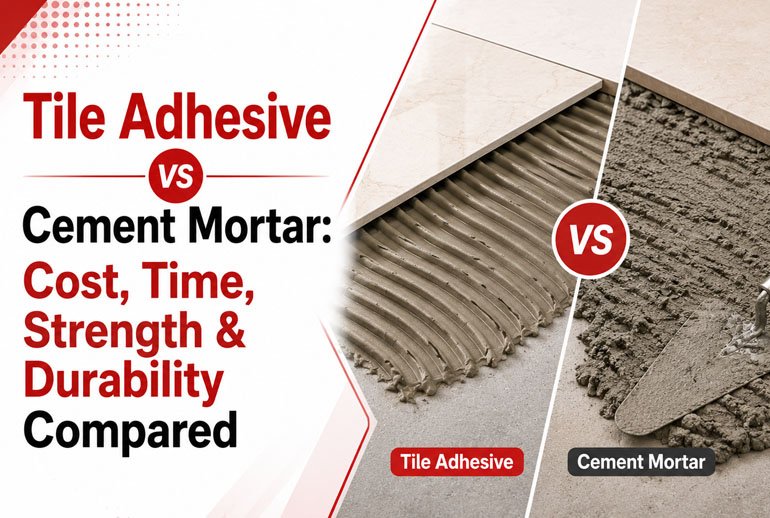
Tile Adhesive vs Cement Mortar: Cost, Time, Strength & Durability Compared
In contemporary houses and offices, tiles are predominantly used for their durability, ease of maintenance, and decorative appeal. Nonetheless, a significant portion of the duration of the tiles depends on the process of fixing them. Mortar has always been applied to secure tiles but tile adhesive is a new product that is currently gaining popularity in installing tiles. Knowledge surrounding the disparities between these two alternatives can be used to select the correct solution to any tiling initiative.
Knowing Tile Adhesive and Cement Mortar
Cement mortar is an ancient blend of cement, sand and water which has been established in construction over the decades. It is normally used in a thick coating and it must be mixed by hand.
On the other hand, tile adhesive is a specially developed bonding material that is to be used in the installation of tiles. It normally exists as a ready-to-mix powder and includes additives which enhance bonding strength, flexibility and water resistance.
Cost Comparison
Cement mortar can appear more cost-effective to people since it requires only simple construction tools such as sand and cement, at the onset. The total price however may rise because of the need to do more labor and waste in the mixing.
Toggle adhesive can seem a little more per bag, although it can be laid down in less depth, and less of it is needed. The overall cost of the project is usually similar or even less in most instances since it will lessen wastage and accelerate the installation process.
Time and Ease of Installation
Installation time is among the largest variations of the two approaches.
Cement mortar is an on-site mixture which needs to be mixed, the surface prepared and then properly leveled. This is a demanding and time consuming process that requires expertise. Besides, tiles could require soaking prior to being laid down when mortar is to be used.
The process is made easy by tile adhesive. It only needs to be mixed with water, and it can be applied straight off with a notched trowel. The slimmer application layer and quicker setting period contribute to the saving of considerable time on installation, which is why it is the favorite in contemporary construction works.
Performance of Strength and Bonding
Strength is important in ensuring that the tiles do not become loose or crack with time.
Conventional cement mortar is primarily based on mechanical attachment, i.e. the tile adhesives, since the cement solidifies around it. Although this method is effective in many applications, it may not be so effective in the much larger or heavier tiles.
The tile adhesive is meant to develop more chemical bonding. Polymers and additives enhance attachment between the tile and the substrate, which is more resistant to movement, vibration and temperature variations.
Conclusion
Cement mortar and tile adhesive both serve their purpose in construction, although modern tiling needs usually require a stronger bond, less construction time, and durability. The greater the size of the tiles, the more diversified the surfaces, and the more specialized tile adhesives are becoming popular in relation to the stability of installing a tile.
Such companies as Rockbuild are keen on designing construction material that facilitates the current practice of tiling, which enables building constructors and home owners to obtain sturdier and more enduring tile systems.