
- By admin-theme
- Uncategorized
- 0 Comment
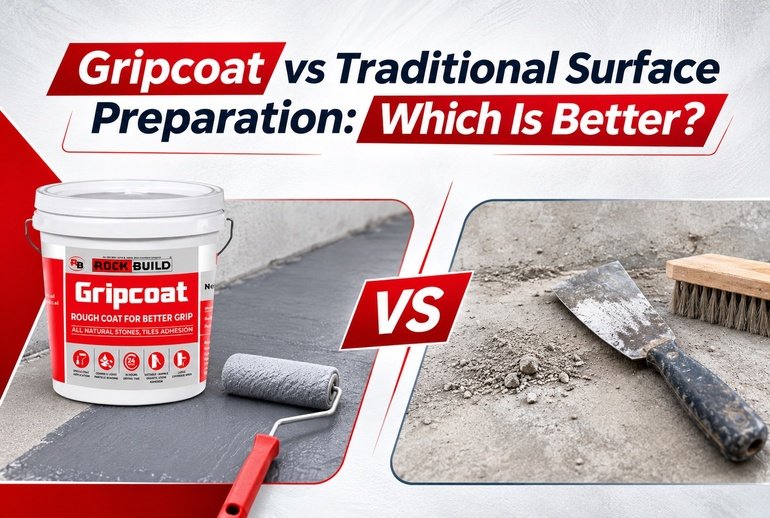
Gripcoat vs Traditional Surface Preparation: Which Is Better?
When installing tiles, marble, or granite over smooth and low-absorption surfaces, surface preparation plays a major role in determining how well the adhesive bonds. Traditional methods such as hacking, grinding, sanding, or removing an existing surface can improve adhesion, but they may also involve considerable labour, dust, noise, and time. Gripcoat offers a different approach by creating a textured layer that helps the adhesive grip the substrate.
But does that make Gripcoat better than traditional surface preparation? The answer depends on the condition and type of substrate, the project requirements, and the recommended installation system. Here is a practical comparison to help you decide.
What Is Gripcoat?
Gripcoat is a preparatory rough coat applied over smooth or non-porous surfaces before applying tile adhesive. Rock Build GRIPCOAT is designed to create a textured surface that improves adhesive grip on substrates such as existing tiles, polished concrete, marble, and granite.
It can be particularly useful for:
- Tile-on-tile installation
- Smooth concrete surfaces
- Marble and granite
- Renovation projects
- Low-absorption substrates
- Re-tiling without extensive removal work
What Is Traditional Surface Preparation?
Traditional preparation generally involves physically preparing the substrate so that the adhesive can bond properly. Depending on the surface, this may include cleaning, scraping, hacking, sanding, grinding, or removing old finishes.
For example, dense concrete may need mechanical roughening to create an appropriate surface profile for adhesive bonding.
The usual process includes:
- Removing dust, grease and loose particles.
- Removing weak or damaged material.
- Grinding, hacking or sanding smooth areas.
- Cleaning the prepared surface.
- Checking the surface before applying adhesive.
Gripcoat vs Traditional Surface Preparation
Factor | Gripcoat | Traditional Preparation |
Surface roughening | Creates a textured bonding layer | Physically roughens the substrate |
Dust generation | Generally lower | Can be significant with grinding/hacking |
Labour | Relatively convenient | Often labour-intensive |
Renovation work | Useful for existing surfaces | May require removal or extensive preparation |
Smooth surfaces | Suitable when recommended | Requires mechanical treatment |
Project downtime | Can reduce preparation effort | May take longer |
Surface condition | Substrate must still be sound and clean | Damaged areas can be removed during preparation |
The key point is that Gripcoat does not replace basic surface preparation. The substrate should still be clean, sound, and free from contaminants. Industry guidance also emphasizes that adhesive performance depends heavily on proper substrate preparation.
Why Choose Gripcoat for Renovation Projects?
Renovation projects often involve existing tiles, polished stone, or other difficult-to-bond surfaces. Removing the entire existing finish can increase labour and generate debris.
A Gripcoat system can provide a practical alternative where the existing substrate is suitable. By creating a rougher bonding surface, it helps tile adhesive establish better mechanical contact with smooth substrates.
For instance, if a homeowner wants to install new tiles over an existing tiled surface, using an appropriate bonding preparation can be more convenient than completely dismantling the old flooring.
When Is Traditional Preparation Better?
Traditional preparation remains important when the substrate has serious defects. Loose, hollow, cracked, contaminated, or structurally weak areas should not simply be covered with a preparatory coating.
Mechanical preparation may also be necessary where existing sealers, curing compounds, or other contaminants prevent proper bonding. Technical guidance for concrete surfaces recommends mechanical abrasion in situations where such materials need to be removed.
Therefore, traditional preparation may be preferable when:
- The existing surface is damaged.
- Loose material needs removal.
- Old coatings are failing.
- The substrate requires levelling or repair.
- Heavy contamination must be eliminated.
Which Is Better: Gripcoat or Traditional Preparation?
There is no single solution for every project. Gripcoat can be the better option for smooth, stable and low-absorption surfaces where the objective is to improve adhesive grip without extensive mechanical roughening.
Traditional preparation is more appropriate when the substrate itself needs correction, cleaning, repair, or mechanical treatment.
In many projects, the best approach is actually a combination of proper cleaning and substrate inspection followed by Gripcoat where suitable. The choice should always follow the product manufacturer’s application instructions and the condition of the surface.
Conclusion
Choosing between Gripcoat vs traditional surface preparation depends mainly on the substrate and project requirements. Traditional methods remain essential for removing weak material, contaminants, and defective layers, while Gripcoat can simplify bonding preparation on suitable smooth and non-porous surfaces. For renovation and tile-on-tile applications, Rock Build GRIPCOAT can provide a practical textured base for improved adhesive grip.
For the right product and application method, consult Rock Build and select a surface-preparation solution suited to your project.
Frequently Asked Questions
1. Is Gripcoat better than grinding?
Not in every situation. Gripcoat is useful on suitable smooth and non-porous surfaces, while grinding may be necessary for removing coatings, contaminants, or creating a required concrete profile.
2. Can Gripcoat be used for tile-on-tile installation?
Yes. Gripcoat is specifically suitable for applications such as tile-on-tile fixing where the existing surface is stable and appropriate for the system.
3. Does Gripcoat eliminate surface cleaning?
No. The substrate still needs to be properly cleaned and free from dust, grease, loose material, and other contaminants before application.
4. Can Gripcoat be used on marble and granite?
It can be used on suitable marble and granite surfaces to create a textured layer that supports better adhesive grip.
5. Which method is better for renovation?
Gripcoat can be convenient for stable existing surfaces, while traditional preparation is preferable where the old surface is damaged, loose, contaminated, or requires substantial correction.