
- By admin-theme
- Uncategorized
- 0 Comment
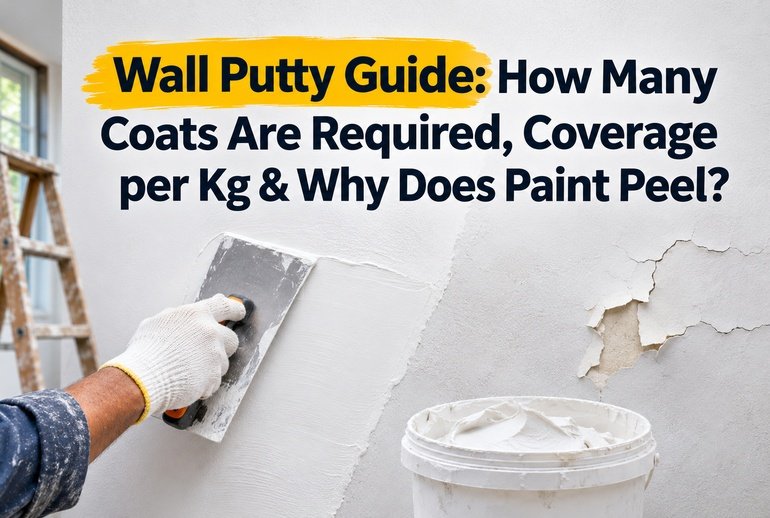
Wall Putty Guide: How Many Coats Are Required, Coverage per Kg & Why Does Paint Peel?
A smooth and attractive wall finish depends on more than just choosing the right paint colour. Proper surface preparation plays an equally important role, and wall putty is one of the essential materials used before painting. It helps create an even surface, fills minor imperfections, and improves the overall appearance of painted walls. However, homeowners and contractors often have questions about the number of putty coats required, coverage per kilogram, and reasons behind paint peeling. Understanding these details can help prevent unnecessary material wastage and finishing problems. Rock Build offers wall putty designed for interior and exterior wall finishing, providing a suitable base for painting projects. This guide explains the application process, coverage, common mistakes, and practical ways to achieve a smooth and lasting wall finish.
Understanding Wall Putty and Its Role in Wall Finishing
Wall putty is a finishing material applied to interior and exterior walls to create a smooth, uniform surface before painting. It helps fill minor pores and surface irregularities while improving the appearance of the final paint finish.
According to the Rock Build product catalogue (page 16), Rock Build Wall Putty is a white cement-based putty designed for finishing and decorating different types of walls. It can be applied to fresh and old painted walls after removing loose paint and preparing the base coat.
Key benefits include:
- Creates a smooth surface for painting.
- Helps protect walls against moisture and flaking.
- Offers strong adhesion with the base surface.
- Provides better coverage for costly paints.
- Helps prevent fungal and algae growth.
How Many Coats of Wall Putty Are Required?
Generally, two coats of wall putty are recommended to achieve a smooth and even surface before painting. The exact requirement depends on the wall condition, surface texture, and manufacturer’s instructions.
- First coat: Fills minor pores and surface imperfections while creating an even base.
- Second coat: Provides a smoother finish and helps prepare the wall for painting.
Allow the first coat to dry properly before applying the second. Once the surface is ready, light sanding can help remove minor unevenness. Avoid applying excessively thick layers, as this may affect the finish.
Wall Putty Coverage per Kg: Understanding Material Requirements
Coverage depends on surface porosity, application thickness, wall condition, and application technique.
As mentioned in the Rock Build product catalogue on page 16, Rock Build Wall Putty offers approximately 18–20 sq. ft. per kg for two coats.
Putty Quantity | Approximate Coverage |
1 kg | 18–20 sq. ft. |
10 kg | 180–200 sq. ft. |
20 kg | 360–400 sq. ft. |
40 kg | 720–800 sq. ft. |
These figures are indicative. Actual coverage may vary depending on the wall surface and application thickness.
Common Reasons Behind Paint Peeling After Putty Application
Paint peeling can spoil an otherwise well-finished wall. It usually happens because of improper surface preparation, moisture problems, or incorrect application.
Some common reasons include:
- Damp walls: Water seepage and moisture can weaken the bond between paint and the underlying surface.
- Poor surface preparation: Dust, loose particles, and old flaking paint can affect adhesion.
- Incorrect application: Applying putty without following the recommended method can create finishing problems.
- Insufficient drying: Applying paint before the putty has dried adequately can affect the final finish.
- Low-quality materials: Unsuitable or incompatible products may result in poor bonding.
Always identify and resolve moisture problems before starting putty and painting work.
Professional Application Practices for a Better Finish
Following the correct application process helps improve wall appearance and material performance.
- Clean the wall and remove dust, loose paint, and other impurities.
- Prepare the putty according to the manufacturer’s instructions.
- Apply the first coat evenly using a suitable putty knife.
- Allow the surface to dry before applying the second coat.
- Sand gently if required to achieve a uniform finish.
- Apply a suitable primer and paint according to their product instructions.
One useful detail from Rock Build’s catalogue is that its wall putty is described as ready to mix and apply, available in dry form, and requiring no curing.
Conclusion
Choosing the right wall putty and following proper application practices are essential for achieving smooth, attractive, and durable walls. Understanding the recommended two-coat application, approximate coverage per kg, and common reasons for paint peeling can help avoid unnecessary repairs and material wastage. Rock Build Wall Putty offers a finishing solution for interior and exterior wall applications. Choose Rock Build for your wall-finishing requirements and prepare your surfaces for a better painting experience.
Planning your next painting or renovation project? Explore Rock Build Wall Putty and other construction solutions to achieve a professional-looking wall finish.
Frequently Asked Questions
1. How many coats of wall putty should be applied before painting?
Generally, two coats are recommended for a smooth finish. The number may vary depending on the wall condition, surface imperfections, and manufacturer’s application guidelines.
2. What is the coverage of 1 kg wall putty?
According to the Rock Build product catalogue, approximately 1 kg of Rock Build Wall Putty covers 18–20 sq. ft. in two coats. Actual coverage depends on surface conditions and application thickness.
3. Why does paint peel after applying wall putty?
Paint may peel because of dampness, poor surface preparation, dust, insufficient drying, or improper application. Preparing the wall correctly before painting helps minimise these problems.
4. Is wall putty required before applying paint?
Wall putty is commonly used to smooth uneven surfaces, fill minor pores, and prepare walls for painting. It helps achieve a more uniform finish, although the exact requirement depends on the existing wall condition.
5. Does wall putty require curing with water?
It depends on the product formulation. Rock Build Wall Putty is described in its product catalogue as requiring no curing, making application more convenient.