
- By admin-theme
- Uncategorized
- 0 Comment
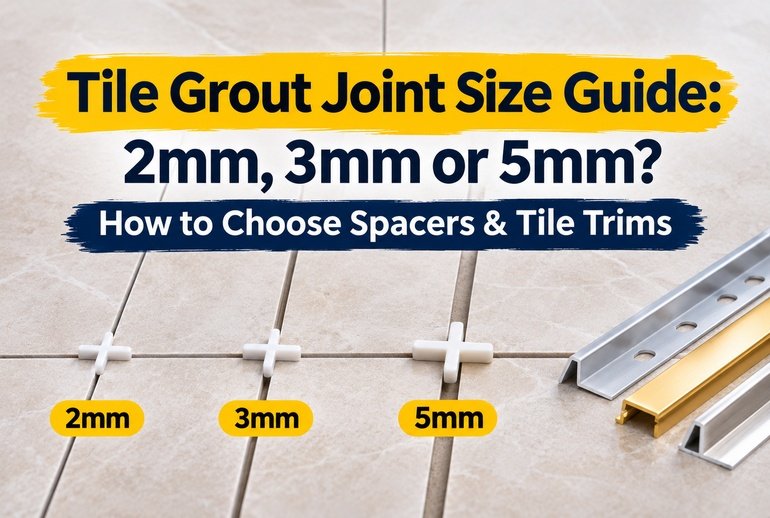
Tile Grout Joint Size Guide: 2mm, 3mm or 5mm? How to Choose Spacers & Tile Trims
A beautiful tile installation is not just about selecting attractive tiles; the finishing details also play an important role in the overall appearance and durability of a surface. One such detail is the grout joint size. Choosing between 2mm, 3mm, or 5mm gaps can influence the final look, alignment, and maintenance of tiled floors and walls. The right tile spacers and tile trims also help achieve neat edges and uniform spacing. Whether you are renovating a bathroom, designing a kitchen, or installing tiles in a commercial property, understanding grout joint requirements can prevent common installation problems. Rock Build offers tile grouts, spacers, and tile installation accessories designed to support accurate and professional tile finishing.
Understanding Tile Grout Joint Sizes and Their Importance
A grout joint is the gap left between two adjoining tiles. It is filled with grout to create a finished surface and accommodate minor variations in tile dimensions.
The correct joint size depends on several factors:
- Tile size and manufacturing tolerance.
- Whether the tile has rectified or non-rectified edges.
- Installation location and surface conditions.
- Manufacturer recommendations.
- Design preferences and grout type.
Smaller joints create a more continuous appearance, while wider joints provide greater room for accommodating dimensional variations.
2mm, 3mm and 5mm Grout Joints: Finding the Right Fit
Each grout joint size serves a different installation requirement. The choice should consider tile edges, dimensions, application area, and grout manufacturer’s instructions.
Joint Size | Suitable Application | Key Consideration |
2mm | Rectified tiles and neat wall finishes | Creates a minimal joint |
3mm | Common floor and wall tile installations | Offers a balanced appearance |
5mm | Tiles with greater dimensional variation | Provides wider spacing |
2mm grout joint: Suitable for accurately manufactured rectified tiles where the manufacturer permits narrow joints. It creates a clean, modern appearance.
3mm grout joint: A practical option for many residential tile installations. It provides slightly more room for alignment adjustments and grout application.
5mm grout joint: Often considered for tiles with more noticeable dimensional variations or designs requiring wider joints. It can also create a more traditional tiled appearance.
Always follow the tile manufacturer’s minimum joint-width recommendations rather than selecting a size based only on appearance.
Choosing the Right Tile Spacers for Accurate Alignment
Tile spacers help maintain consistent gaps between adjoining tiles during installation. They are particularly useful when covering larger areas where even spacing is important.
Rock Build features tile spacers in 2mm, 3mm, 4mm, 5mm, 6mm, and 8mm sizes.
Consider these points when selecting spacers:
- Match the spacer size with your planned grout joint.
- Select quality spacers that maintain their shape during installation.
- Check tile dimensions and edge consistency before fixing.
- Use a levelling system where necessary to manage uneven tile edges.
Tile Trims for Clean Edges and Professional Finishing
Tile trims provide a neat finish along exposed tile edges, corners, and transitions. They also help protect vulnerable edges from accidental chipping.
Common applications include:
- Bathroom wall corners and shower edges.
- Kitchen backsplashes and countertop boundaries.
- External wall corners.
- Transitions between different flooring materials.
Choose a trim profile and thickness compatible with the tile and adhesive build-up. Proper installation during tile fixing generally produces a cleaner result than adding trims afterwards.
Selecting the Right Grout for Long-Lasting Joints
Grout selection is just as important as joint width. Rock Build’s catalogue (pages 18–21) includes cement-based tile grout and epoxy grout options.
- Cement-based tile grout: Available in 16 colours, designed for joints from 1mm to 3mm on non-absorbent and vitreous tiles. It can be mixed with Rock Build Admix for improved performance.
- Epoxy grout: A two-component option offering stain resistance, chemical resistance, and water resistance.
- Sparkle epoxy grout: Designed for decorative finishes with metallic-style colour options.
The appropriate grout depends on tile type, joint dimensions, exposure to moisture, and maintenance requirements.
Conclusion
Choosing between 2mm, 3mm, and 5mm grout joints depends on tile dimensions, edge quality, installation conditions, and design preferences. Using correctly sized tile spacers, suitable tile trims, and compatible grout helps achieve a neat and durable finish. Rock Build provides tile grouts and installation accessories to support accurate tile installation and professional finishing.
Planning a tile installation project? Explore Rock Build’s range of tile grout, spacers, tile trims, and other installation solutions to find products suited to your requirements.
Frequently Asked Questions
1. Is a 2mm grout joint suitable for floor tiles?
A 2mm joint can work with suitable rectified tiles when permitted by the manufacturer. However, tile dimensions, installation conditions, and grout specifications should be checked before proceeding.
2. Which tile spacer size is most commonly used?
The choice depends on the tile and desired joint width. Rock Build offers 2mm, 3mm, 4mm, 5mm, 6mm, and 8mm tile spacers for different installation requirements.
3. Can 5mm grout joints be used for bathroom tiles?
Yes, provided the tile manufacturer’s recommendations and grout specifications allow it. Wider joints may be useful for certain tile types and layouts.
4. What is the difference between cement grout and epoxy grout?
Cement grout is a cement-based joint-filling material, while epoxy grout uses resin components. Epoxy grout generally offers better stain and chemical resistance, making it suitable for demanding applications.
5. Why are tile trims important during installation?
Tile trims provide finished edges and help protect exposed tile corners. They also create a cleaner transition between tiled surfaces and adjoining materials.
6. Does Rock Build offer different grout colours?
Yes. Rock Build’s cement-based tile grout is available in 16 colours. Its epoxy and sparkle epoxy grout ranges also offer multiple colour options for decorative and functional tile joints.