
- By admin-theme
- Uncategorized
- 0 Comment
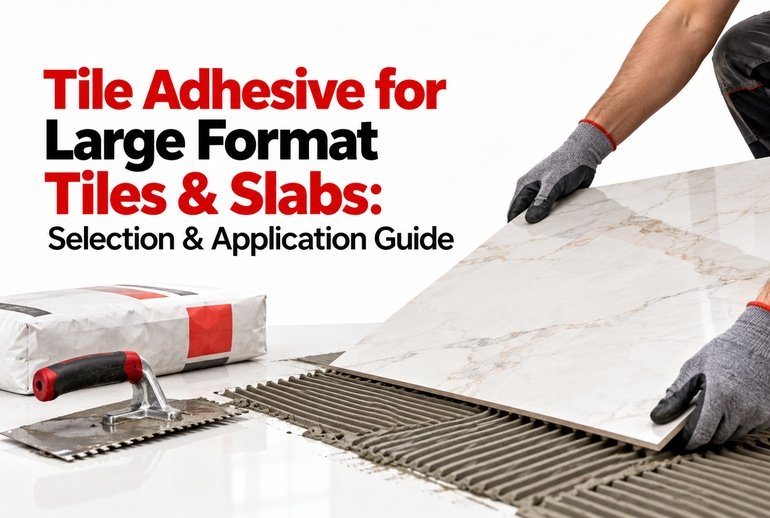
Tile Adhesive for Large Format Tiles & Slabs: Selection & Application Guide
Large format tiles and slabs can give floors and walls a clean, luxurious appearance, but installing them requires more care than standard tiles. The right tile adhesive for large format tiles helps provide proper bonding, reduces the risk of hollow spots and improves long-term stability. Choosing an adhesive only by its price or basic bonding strength may not be enough for heavy, oversized tiles.
For large porcelain tiles, vitrified tiles and slabs, installers need to consider the tile size, weight, surface condition, adhesive coverage, working time and application method. This guide explains how to select and apply tile adhesive for large format tiles and slabs while avoiding common installation mistakes. With the right product and technique, Rock Build helps support reliable tile installation for demanding residential and commercial applications.
Why Do Large Format Tiles Need Special Adhesive?
Large format tiles have a greater surface area and can be heavier than conventional tiles. Their size also makes it more difficult to achieve uniform contact between the tile and substrate.
A suitable adhesive should provide:
- Strong and consistent bonding
- Good coverage across the tile surface
- Adequate open time for positioning
- Resistance to tile movement
- Compatibility with the tile and substrate
- Better control over sagging on vertical surfaces
Using an unsuitable adhesive can result in debonding, cracked joints, hollow areas or tiles becoming loose over time.
How to Select Tile Adhesive for Large Format Tiles
The right adhesive depends on the project rather than simply the tile’s appearance. Before purchasing, consider these important factors.
Tile Size and Weight
The larger and heavier the tile, the more important it becomes to use an adhesive designed for demanding applications. Very large slabs may also require specialised installation practices recommended by the manufacturer.
Tile Material
Porcelain, vitrified tiles, natural stone and other materials can have different absorption levels. Low-absorption tiles generally need an adhesive capable of forming a reliable bond with dense surfaces.
Substrate Condition
The floor or wall must be sound, clean and properly prepared. Dust, grease, loose material, moisture or uneven surfaces can affect adhesion even when a high-quality adhesive is used.
Application Location
Indoor floors, walls, bathrooms, balconies, terraces and other areas can have different requirements. Areas exposed to moisture or temperature changes may require an adhesive suitable for those conditions.
How to Apply Tile Adhesive for Large Format Tiles
Correct application is just as important as selecting the product.
1. Prepare the Surface
Remove dust, oil, loose particles and other contaminants. Check that the substrate is sufficiently level and structurally sound. Significant unevenness should be corrected before adhesive application.
2. Mix the Adhesive Correctly
Follow the manufacturer’s specified water ratio and mixing instructions. Avoid adding excessive water because it can affect the adhesive’s performance. Allow the mixture to mature if the product instructions require it.
3. Apply with the Right Notched Trowel
Spread the adhesive evenly over the prepared substrate using an appropriate notched trowel. For large format tiles, maintaining consistent ridges is important for achieving better coverage.
4. Use Back Buttering Where Required
For large tiles and slabs, applying a thin layer of adhesive to the back of the tile can help improve contact. The exact method should follow the adhesive manufacturer’s recommendations and project requirements.
Common Mistakes to Avoid
Even a good adhesive may fail when installation practices are poor. Avoid:
- Applying adhesive over a dusty or unstable surface
- Mixing with more water than recommended
- Using an unsuitable adhesive for the tile type
- Applying adhesive beyond its workable time
- Ignoring substrate unevenness
- Failing to achieve adequate adhesive coverage
- Walking on newly installed tiles too soon
Following the manufacturer’s technical instructions is essential, especially for unusually large or heavy slabs.
Large Format Tile Adhesive: A Quick Comparison
Factor | Standard Tile Installation | Large Format Tile Installation |
Tile size | Small to medium | Large or oversized |
Adhesive requirement | General-purpose options may work | Higher-performance suitable adhesive |
Coverage | Relatively easier | Requires careful, uniform coverage |
Handling | Easier | Requires greater care and support |
Installation technique | Standard application | Notched trowel and back buttering where required |
Conclusion
Choosing the right tile adhesive for large-format tiles is an important part of achieving a durable and stable installation. Tile size, material, substrate condition and application environment should all be considered before selecting an adhesive. Proper surface preparation, mixing, adhesive coverage and tile placement are equally important.
For dependable tile installation, explore suitable Rock Build adhesive solutions and select the product according to your project’s tile and substrate requirements.
Frequently Asked Questions
1. What is the best tile adhesive for large-format tiles?
The best adhesive depends on the tile material, size, substrate and installation location. A suitable high-performance adhesive should provide reliable bonding and adequate coverage.
2. Is back buttering necessary for large-format tiles?
Back buttering may be recommended for large-format tiles to improve adhesive contact. Always follow the manufacturer’s application instructions.
3. Can regular tile adhesive be used for large slabs?
Not necessarily. Large slabs may require an adhesive specifically suitable for their size, weight and low-absorption characteristics.
4. How can hollow spots under large tiles be avoided?
Use proper substrate preparation, consistent adhesive application and sufficient coverage. Periodically checking the back of installed tiles can help identify coverage problems.
5. Why is surface preparation important before applying tile adhesive?
Dust, grease, loose particles and uneven surfaces can reduce adhesive contact and compromise the installation.