
- By admin-theme
- Uncategorized
- 0 Comment
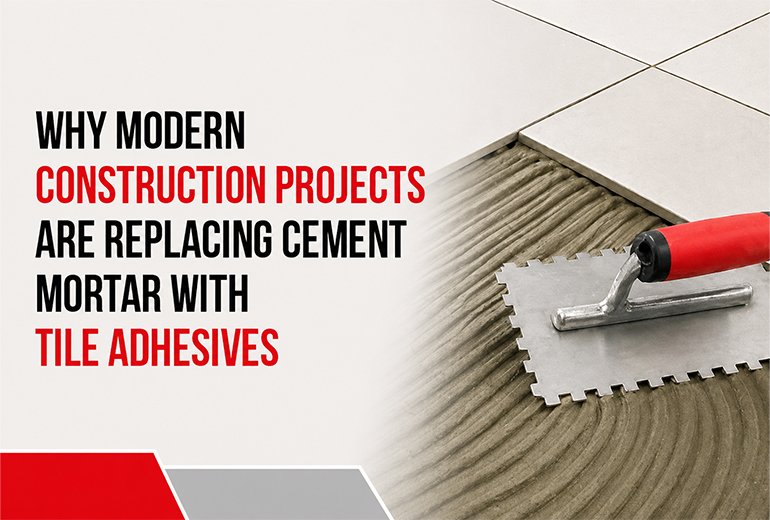
Why Modern Construction Projects Are Replacing Cement Mortar with Tile Adhesives
How the construction industry has evolved in the past 10 years. Builders, architects and construction companies are always seeking materials that enhance the quality of their construction, minimise installation time and maximise its durability. The most significant development in the construction industry in recent years is the advent of tile adhesive for installing tiles, compared with traditional cement mortar. The superior performance and convenience for residential, commercial and infrastructure projects make tile adhesive a preferred choice today.
Understanding the Difference
Traditional cement mortar is a combination of cement, sand, and water and has been used for decades to fix tiles. Although useful in the past, it frequently requires expertise in its deployment, extensive preparation and a thicker application layer.
A tile adhesive, however, is a specially formulated adhesive used to ensure good tile adhesion to surfaces. It comes in ready-to-use or powder format and provides consistent quality during the installation.
Improved bond strength and durability.
The ability to bond is one of the primary reasons for construction projects turning to tile adhesive. Vitrified and porcelain tiles are common modern tiles with low porosity that require stronger adhesion than traditional mortar.
High-quality tile adhesive products have been proven to have much greater bond strength, which helps prevent tile lifting, cracking, and loosening over time. This helps to make structures more durable and less expensive to maintain.
Rapid and efficient installation
Time is an essential component in today’s building. Contractors speed up projects by using tile adhesive because it is easier to prepare and apply than cement mortar and can be applied in a thinner layer.
Uniform consistency of tile adhesive further reduces errors in tile installation, helping workers produce more consistent results in less time. It is particularly beneficial in large commercial and residential developments.
Reduced Material Wastage
The traditional mortar tends to be applied unevenly and waste material. On the other hand, tile adhesive is produced with controlled formulations that make optimal use of the adhesive. This time, contractors can estimate quantities more accurately, thereby minimising unnecessary material waste and better managing project costs.
Moreover, with thinner application layers, there is less load on the building structure and excellent tile bonding performance.
Works great with modern tile designs
Large-format tiles, natural stone, and designer surfaces are often used in modern architecture. Advanced bonding solutions are needed for these materials, as traditional mortar can sometimes be inadequate.
A good tile adhesive will have flexibility, water resistance, and compatibility with various substrates, making it suitable for modern construction requirements. It is also moisture-resistant and is widely used in bathrooms, kitchens, balconies, etc.
Conclusion
The rise in popularity of tile adhesive over traditional cement mortar reflects the construction industry’s emphasis on efficiency, durability, and sustainability.
Rock Build is aware of the evolving needs of contemporary buildings and the importance of improving tile-setting technology to deliver sturdy, high-quality buildings.
FAQs
1. Why is tile adhesive considered better than cement mortar?
Tile adhesive provides stronger bonding, easier application, and better durability. It also reduces the chances of tile cracking or detachment, making it a more reliable solution for modern construction projects.
2. Can tile adhesive be used for all types of tiles?
Yes, most tile adhesives are designed to work with ceramic, porcelain, vitrified, and natural stone tiles. Different formulations are available depending on the tile type and installation area.
3. Does tile adhesive reduce construction time?
Yes. Tile adhesive requires less preparation and can be applied quickly and evenly, helping contractors complete tile installation faster than traditional cement mortar methods.
4. Is tile adhesive suitable for wet areas?
Tile adhesive performs well in wet environments such as bathrooms, kitchens, and balconies. Many products are specifically designed to provide moisture resistance and long-lasting performance.
5. Does tile adhesive help reduce material wastage?
Yes. Tile adhesive offers controlled application and accurate consumption rates, which minimise wastage and help improve overall project efficiency and cost management.