
- By admin-theme
- Uncategorized
- 0 Comment
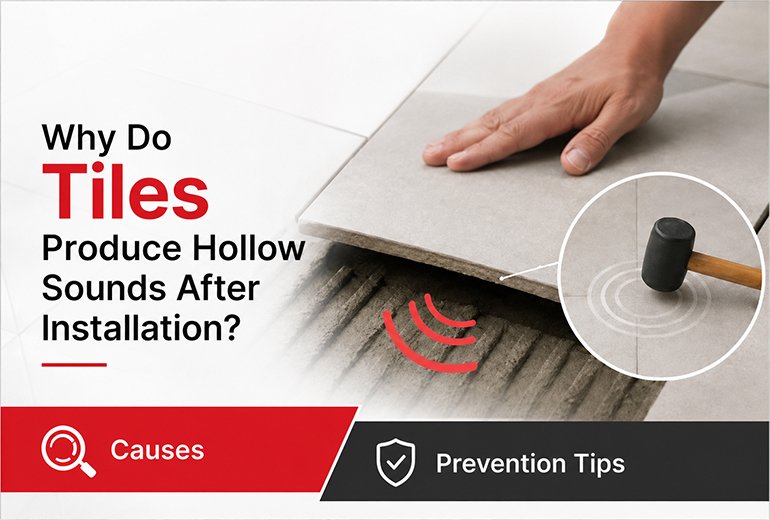
Why Do Tiles Produce Hollow Sounds After Installation? Causes & Prevention Tips
Tiles are among the most widely used wall and floor finishing materials in residential, office, and business settings. Some property owners, however, will find that after installation, some tiles will give a hollow sound when tapped. This can lead to questions about the quality of the tile job and its durability.
Why does hollow-sounding produce sound?
If it sounds hollow, there is likely a void (space) or an insufficient bond between the tile and the underlying substrate. Not all hollow tiles are hazardous, but if left unaddressed, they may pose an issue.
1. Insufficient Adhesive Coverage
One of the most common reasons for hollow-sounding tiles is inadequate tile adhesive coverage. If adhesive is not applied uniformly or too little is applied, air pockets will be trapped under the tile. These gaps produce the hollow sound heard when tapped.
2. Damage caused by a subfloor or wall surface
Without adequate levelling before tile laying, some surfaces may not adhere properly to the adhesive. This will cause voids to form beneath the tiles, resulting in a hollow sound and reduced stability.
3. Improper Installation Techniques
Repeatedly, large tiles are not laid under the tile, resulting in gaps due to improper installation, including rushing the laying process and not leaving space for the tile to be back-buttered. Professional installers use typical guidelines for bonding and support.
4. Adhesive Drying too quickly
Environmental factors also have an impact. If the tiles are not secured to the surface, the tile adhesive may dry out due to high temperatures, direct sun or strong airflow. This reduces the bond strength and can lead to voids.
5. Structural Movement
The natural expansion and contraction of buildings, along with the natural settlement, are the contributing factors. Without expansion joints, the tiles will eventually begin to partially separate from the substrate, causing them to sound hollow.
Why is it important to address hollow tiles?
Research in the flooring industry has shown that tiles with a high number of voids beneath them are more prone to cracking under heavy loads. Another problem they may encounter is that hollow tiles can loosen over time, leading to higher maintenance and repair costs.
Tips to prevent hollow-sounding tiles
Provide Good Surface Preparations
Before installing the tile, the substrate should be clean, dry, and level. Proper preparation helps achieve better adhesive bonding.
Use the Right Adhesive
Proper selection of an adhesive appropriate for the tile type and installation site is critical to ensuring long-term durability.
Follow Recommended Installation Practices
The right-sized trowel, the proper amount of adhesive, and good tile-to-substrate contact can minimise hollow spots.
Proper Curing Time
Do not walk on newly installed tiles until the adhesive has set up as per the manufacturer’s instructions.
Conclusion
Typically, hollow-sounding tiles are caused by air gaps, low surface adhesion, uneven surfaces, and installation errors. Early diagnosis will help prevent future damage and expensive repairs. When installing tiles, it is important to understand proper methods to ensure a long-lasting tiled surface.
Rock Build is dedicated to providing solutions that ensure strong bonding, durability, and enhanced performance in modern tile installation systems, where quality construction materials and reliable installation practices are required.
FAQs
1. Are hollow-sounding tiles always defective?
Not necessarily. Some hollow-sounding tiles may remain stable for years. However, large voids beneath tiles can increase the risk of cracking, loosening, or future damage.
2. How can I identify hollow tiles?
A hollow tile usually produces a different sound when tapped than a well-bonded tile. Professionals often use tapping methods to locate voids beneath tiled surfaces.
3. Can hollow tiles be repaired without replacement?
In some cases, specialised injection methods can fill small voids. However, severely affected tiles may need to be removed and reinstalled properly.
4. Do large-format tiles develop hollow spots more often?
Yes. Large-format tiles require proper adhesive coverage and installation techniques. Any gaps beneath these tiles are more noticeable and can create hollow sounds.
5. How much adhesive coverage is recommended?
Industry standards generally recommend high adhesive coverage, often 80–95% or higher, depending on the application area, tile size, and exposure conditions.